
How to Reduce Downtime in Flexo Folder Gluer Production
Every minute of downtime on a flexo folder gluer (FFG) production line represents lost productivity, delayed deliveries, and increased operating costs. In today's competitive corrugated packaging industry, maximizing machine uptime is essential for maintaining profitability and meeting customer expectations.
While unexpected breakdowns can never be completely eliminated, many causes of downtime are preventable through proper maintenance, operator training, and equipment optimization.
This article explores the most common causes of downtime and practical strategies to improve production efficiency.
What Is Production Downtime?
Production downtime refers to any period when a flexo folder gluer is unable to produce saleable boxes.
Downtime can be classified into two categories:
Planned Downtime
Scheduled maintenance
Tooling changes
Machine cleaning
Production changeovers
Unplanned Downtime
Mechanical failures
Electrical faults
Board feeding issues
Print registration problems
Stacker or conveyor jams
Reducing unplanned downtime should be a priority for every corrugated plant.
Common Causes of Downtime
1. Poor Preventive Maintenance
Many unexpected failures occur because wear components are not inspected or replaced before they fail.
Areas requiring routine inspection include:
Feed rollers
Bearings
Belts
Vacuum systems
Print cylinders
Conveyor chains
A structured preventive maintenance schedule helps identify problems before they stop production.
2. Feeding Problems
Consistent sheet feeding is critical for stable operation.
Common causes include:
Warped corrugated sheets
Incorrect feeder settings
Worn feed rollers
Dust accumulation
Damaged board edges
Even minor feeding inconsistencies can cause jams that interrupt production.
3. Incorrect Machine Settings
Improper setup often leads to repeated adjustments during production.
Typical issues include:
Incorrect print pressure
Poor slotter alignment
Inaccurate folding guides
Improper glue application
Conveyor synchronization errors
Standardized setup procedures help reduce operator variation and improve consistency.
4. Operator Experience
Even highly automated equipment depends on skilled operators.
Well-trained operators can:
Detect abnormal machine behavior early
Adjust settings correctly
Reduce setup times
Prevent unnecessary stoppages
Regular training improves both productivity and product quality.
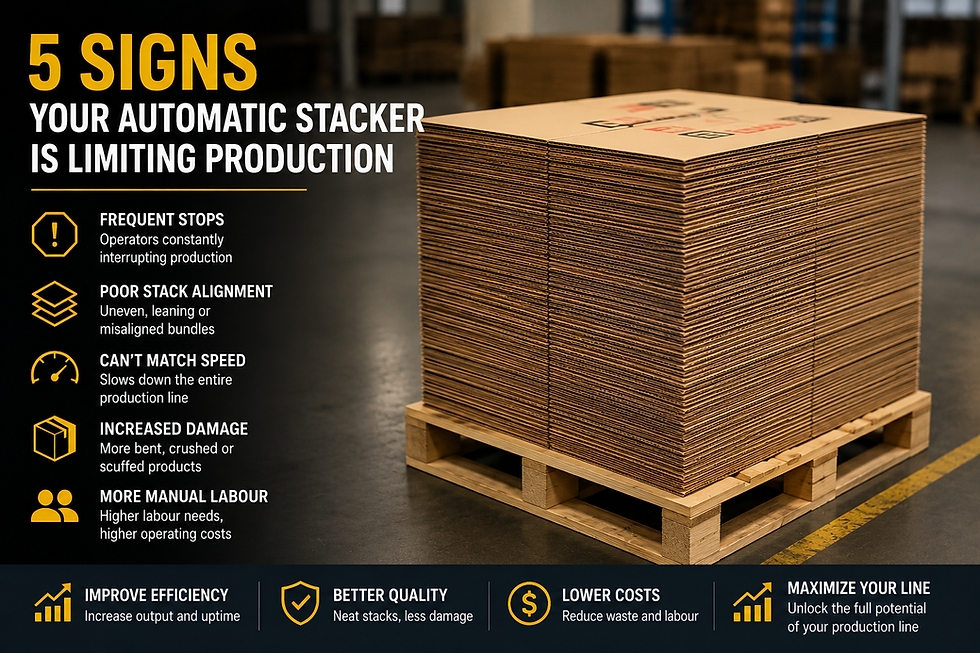
5. Downstream Equipment Bottlenecks
Production speed is often limited by equipment after the flexo folder gluer.
Examples include:
Automatic stackers
Bundle breakers
Counter ejectors
Palletizers
Conveyor systems
If downstream automation cannot keep pace with production, the entire line slows down.
Strategies to Reduce Downtime
Implement Preventive Maintenance
Rather than waiting for failures, schedule routine inspections based on machine operating hours.
A preventive maintenance program should include:
Lubrication schedules
Roller inspections
Belt replacement intervals
Sensor cleaning
Safety system checks
Standardize Machine Setup
Create setup checklists for every production run.
Documenting optimal settings for repeat jobs can significantly reduce changeover times while improving consistency.
Improve Corrugated Board Quality
Consistent board quality reduces:
Feeding problems
Print defects
Folding errors
Machine jams
Work closely with paper suppliers to maintain stable moisture content and board specifications.
Upgrade Material Handling Automation
Modern inline automation helps keep production flowing smoothly.
Automated systems can:
Maintain consistent sheet alignment
Improve stacking quality
Reduce manual handling
Minimize production interruptions
When integrated correctly, automation allows the flexo folder gluer to operate closer to its maximum designed speed.
Monitor Performance Data
Tracking production metrics helps identify recurring issues before they become major problems.
Useful Key Performance Indicators (KPIs) include:
Overall Equipment Effectiveness (OEE)
Downtime frequency
Average repair time
Changeover duration
Production speed
Waste percentage
Continuous monitoring supports data-driven improvements.
Benefits of Reducing Downtime
Improving machine uptime delivers measurable advantages:
Higher production output
Lower operating costs
Better product quality
Improved delivery performance
Reduced overtime
Increased equipment lifespan
Even a small reduction in downtime can have a significant impact on annual production capacity.
Final Thoughts
Reducing downtime is not achieved through a single improvement—it requires a combination of preventive maintenance, operator training, optimized machine settings, consistent board quality, and reliable automation.
As production demands continue to increase, corrugated manufacturers that invest in efficiency and continuous improvement will be better positioned to remain competitive.
Modern flexo folder gluer lines perform best when every stage of the production process—from feeding and printing to stacking and palletizing—is designed to work together seamlessly.
Frequently Asked Questions
What is the biggest cause of flexo folder gluer downtime?
The most common causes include poor preventive maintenance, feeding issues, incorrect machine settings, and downstream bottlenecks.
How can preventive maintenance improve production?
Regular inspections help identify worn components before they fail, reducing unexpected breakdowns and extending equipment life.
Does automation reduce downtime?
Yes. Automated stackers, conveyors, and palletizing systems help maintain continuous material flow and reduce production interruptions caused by manual handling.
Which KPI is most useful for measuring machine efficiency?
Overall Equipment Effectiveness (OEE) is one of the most widely used metrics because it combines machine availability, performance, and product quality into a single measurement.

Comments