
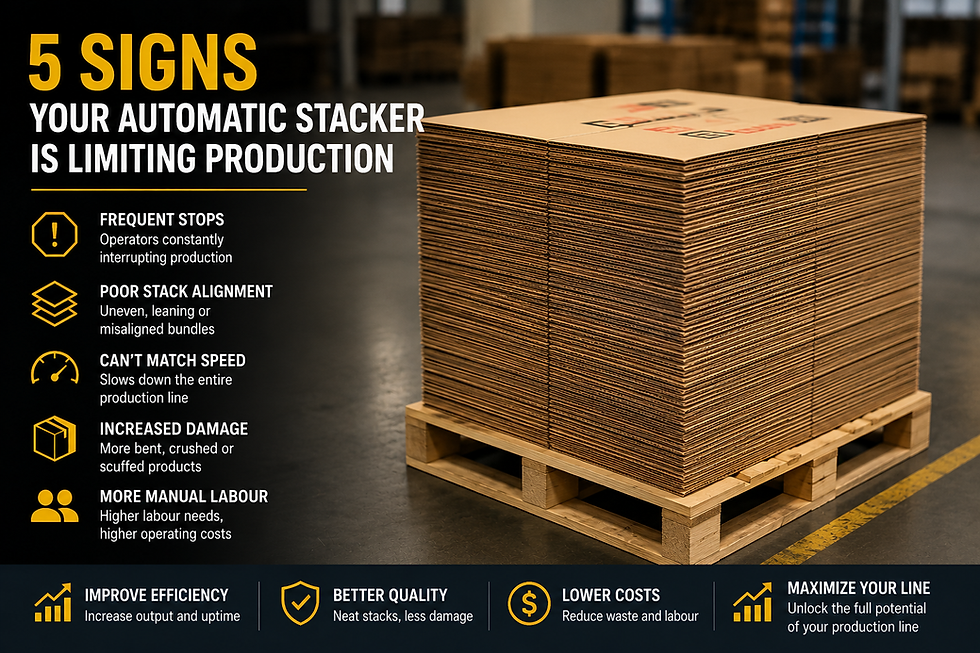
5 Signs Your Automatic Stacker Is Limiting Production
An automatic stacker is designed to keep production flowing efficiently by receiving, aligning, and stacking finished corrugated sheets. However, as production speeds increase and customer demands become more demanding, an outdated or poorly maintained stacker can become a hidden bottleneck.
Many corrugated plants focus on upgrading their flexo folder gluers while overlooking the downstream equipment. In reality, the overall production line can only perform as fast as its slowest component.
If your automatic stacker struggles to keep up, it may be time to evaluate its performance.
Why the Automatic Stacker Matters
The automatic stacker is the final stage of the converting process before bundling and palletizing. Its job is more than simply collecting finished sheets—it must maintain consistent alignment, protect product quality, and support continuous high-speed production.
A high-performing stacker helps:
Maintain stable production speeds
Reduce manual handling
Improve stack quality
Minimize downtime
Prepare bundles for downstream automation
When the stacker cannot keep pace with the production line, efficiency suffers throughout the entire operation.
Sign 1: Operators Frequently Stop the Machine
One of the clearest warning signs is frequent operator intervention.
If operators regularly need to:
Realign stacks
Remove fallen bundles
Clear jams
Adjust stack height manually
the stacker is no longer operating efficiently.
Every unscheduled stop reduces productivity and increases labour costs.
Sign 2: Poor Stack Alignment
Neatly aligned bundles are essential for efficient handling, transport, and palletizing.
Poor stack quality may include:
Leaning stacks
Uneven edges
Misaligned bundles
Collapsed piles
These issues often lead to additional manual rework before shipping or further processing.
Consistent stack quality is especially important for high-volume box manufacturers operating at high production speeds.
Sign 3: The Stacker Cannot Match Machine Speed
Modern flexo folder gluers continue to increase in speed and productivity.
If your stacker forces operators to slow the production line because it cannot receive sheets quickly enough, the stacker has become a production bottleneck.
A properly designed inline stacker should comfortably support the maximum output of the converting line without affecting machine performance.
Sign 4: Increased Product Damage
An inefficient stacker can contribute to unnecessary product damage.
Common problems include:
Crushed corners
Bent sheets
Surface scuffing
Misaligned bundles
Damaged printed graphics
Product damage not only increases waste but may also affect customer satisfaction and delivery quality.
Sign 5: Labour Requirements Keep Increasing
Automation should reduce manual handling—not create more work.
If additional operators are needed simply to:
Collect finished sheets
Re-stack products
Separate bundles
Prepare pallets
your stacking process may no longer be optimized.
Modern automatic stackers are designed to minimize manual intervention while improving production consistency.
Benefits of Upgrading Your Automatic Stacker
Investing in a modern stacking solution offers benefits beyond increased speed.
Potential advantages include:
Higher production efficiency
Reduced labour costs
Better stack quality
Improved operator safety
Lower product waste
Smoother downstream palletizing
For many manufacturers, upgrading the stacker delivers a faster return on investment than replacing the entire converting line.
Choosing the Right Automatic Stacker
Every corrugated plant has different production requirements.
When evaluating a new stacker, consider:
Maximum production speed
Board sizes and flute profiles
Bundle handling requirements
Available floor space
Integration with existing conveyors and palletizers
Future automation plans
Selecting equipment that can grow with your production needs helps protect your investment for years to come.
Final Thoughts
An automatic stacker plays a critical role in maintaining efficient corrugated box production. When it struggles to keep pace with the rest of the production line, the effects can be seen in reduced output, higher labour costs, and lower product quality.
Regular performance reviews and strategic equipment upgrades can eliminate bottlenecks, improve workflow, and maximize the value of your entire converting operation.
If your production team is experiencing frequent stoppages, inconsistent stacking, or increasing manual handling, it may be time to evaluate whether your stacker is supporting—or limiting—your production goals.
Frequently Asked Questions
How do I know if my automatic stacker is too slow?
If operators regularly slow down the flexo folder gluer because the stacker cannot keep up, the stacker has become a production bottleneck.
Can upgrading the stacker improve overall production?
Yes. A faster, more reliable stacker helps maintain continuous material flow, reduces downtime, and allows the converting line to operate at its intended speed.
What are the signs of poor stack quality?
Leaning stacks, uneven edges, collapsed bundles, and damaged products are common indicators that the stacking system needs attention.
Is an inline stacker better for high-speed production?
Inline stackers are often preferred for high-speed corrugated production because they reduce manual handling, improve workflow, and integrate efficiently with downstream automation systems.

Comments